Guatemala Musings
Experiencing Awe
It’s day nine in Guatemala, and the poverty continues to be both oppressive and intriguing. Houses stack one behind the other in the pockets of these steep mountains. The streets are crowded and dirty, air thick with pollution from dirty fuel and old cars. Dogs roam the street, bothering no one other than street vendors.
We finish packing up the hospital after a week of cleft lip and palate surgeries, saying our final “good-byes” and thanking hospital staff. We make sure to add “Hasta el año proximo!”, assuring them of our return next year. An attempted quiet meal turns into lunch for six, another opportunity to share experiences and our humanity in this very different space.
A trip yesterday afternoon to Zacaleu, a Mayan ruins site from some 1600 years ago, was a break that provided fresh air and deep history. This history reminds each of us that we are but a “blip” in time – realities that will fade. I allow myself to feel into this infinite insignificance while also holding the significance of having one small impact on even one person’s life this week.
Where were the touches and impacts during this bit of time? The language of smile – no words necessary. Helping a child find treatment at the last minute. Playing Memory or UNO with children and grandparents alike. Serving simple meals to families and “gelatina” to patients. Facilitating a ride home. Giving a hug. Reminding mothers of just how beautiful their children are.
It is said that in Guatemala there are a few wealthy people, the poor, the very poor, and the destitute. I don’t know who we are serving, but I know that they are kind and patient and humble. They wait for hours to be seen, share a room with many other families without complaint, and help one another in deeds and reassuring words. Their lives are as complicated as ours in many ways, and more so in others. I walk back to the hotel each evening watching men pushing carts and women carrying baskets of food atop their head or babies on their backs. Each of these people has a deep, full life with me as a momentary background character.
Father Greg Boyle once said, “Stand in awe of what the poor have to carry, rather than in judgement of how they carry it.” In Guatemala, I am in awe.
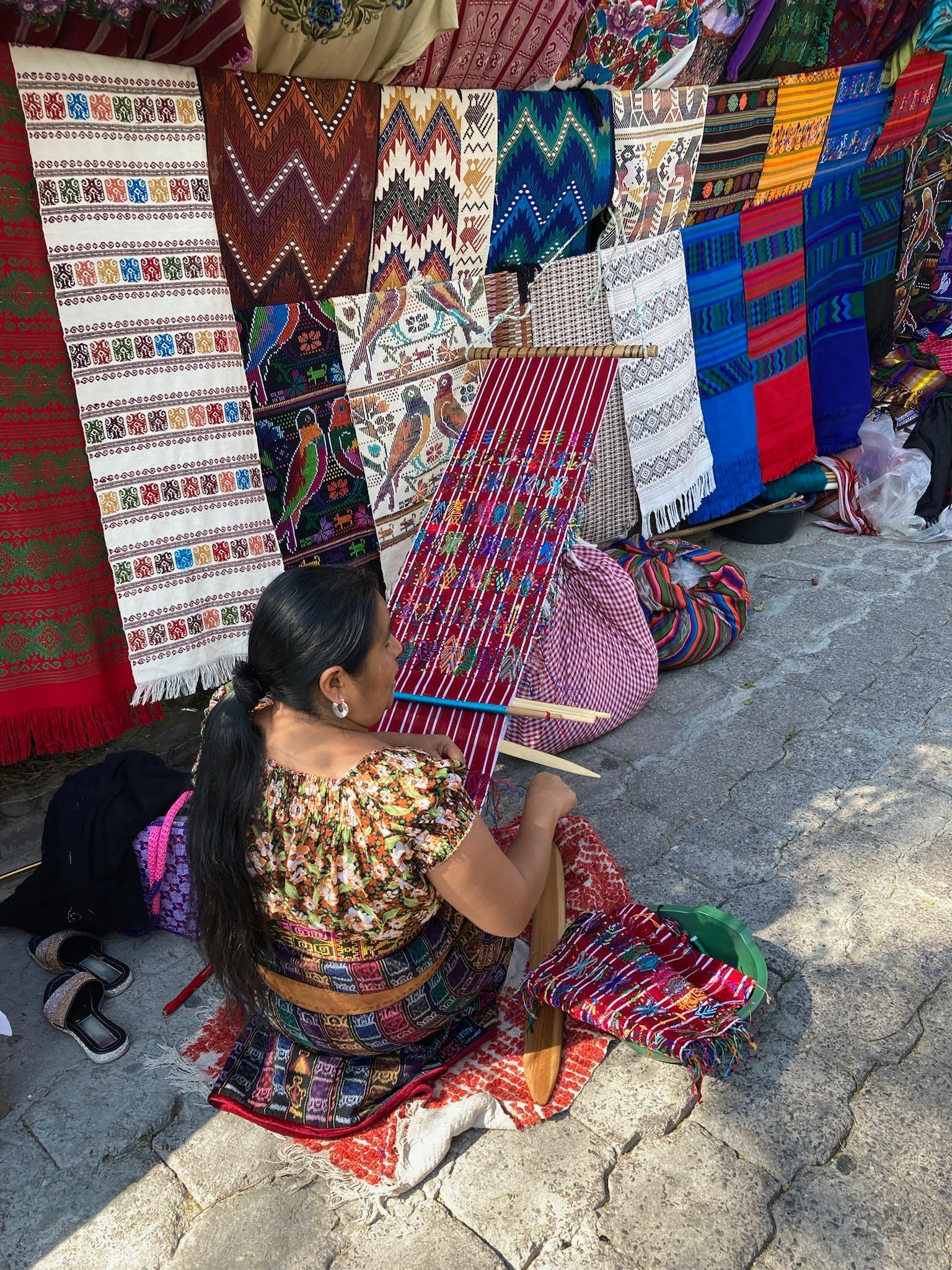
I don’t want to glorify or simplify the life of poverty here. Nor do I want to use a wide brush stroke to describe how everyone lives. The people of Guatemala are as varied and complex as the fabrics they weave and wear. Their work is physically strenuous, from manual farming, to carrying water, to cooking over wood fires. Some weave or bead, and others may be lucky enough to land a job in a factory or hotel. Education is not a given, and many children leave school well before high school.
Yet I do believe this life leads them to a place closer to one another, to creation, and to God.
Henri Nouwen, priest and prolific writer, once wrote, “Poverty is the inner disposition that allows us to take away our defences and convert our enemies into friends. We can only perceive the stranger as an enemy as long as we have something to defend. But when we say, ‘Please enter - my house is your house, my joy is your joy, my sadness is your sadness and my life is your life,’ we have nothing to defend, since we have nothing to lose, but all to give.”
What would life look like if there was nothing to defend and everything to give? It is difficult to imagine that, in a world of unchecked and oft encouraged consumerism, we could ever reach this place. And yet this detachment from wealth and power, and our resulting dependence on God – on “what is”, is the “Kingdom” that Jesus directs us towards. It’s a mindset and felt-knowing that God is infinitely abundant.
News of the death of yet another US citizen, protesting on behalf of immigrants, reaches us in Huehuetenango. I am shocked and saddened, but see this immigration clash clearly coming from a mindset of scarcity and defensiveness. We vilify the stranger, having forgotten that we “belong to each other” as St. Teresa once said.
Perhaps encounter with the poor can lead each of us to more clearly see what we fear needs defending, creating the possibility of inner hospitality and trust. As we hold material things with a more open hand, we may be able to welcome the stranger in a way that honors their dignity as “friend”. And only then will we truly experience the kingdom of shared joy, sorrow, and life – a kingdom not of this culture, but of love.